
Price Down, Open Interest Up: What Does It Mean?
Rising open interest means more contracts remain open. It does not, by itself, predict whether price will rise or fall. When price falls while OI rises, outstanding exposure has expanded during that decline. Binance Academy introduces OI and volume.
What changes open interest?
Each contract has both a buyer and a seller. OI counts one side, rather than adding both sides together. CME explains this counting convention.
Two traders opening new opposing positions increase OI. Two traders closing opposing positions reduce it. When one trader opens and the other closes, OI stays unchanged. All three cases generate trading volume.
OI describes a market’s outstanding contracts. For a trader’s actual long or short positions, see the Hyperliquid wallet lookup guide.
Price down, open interest up: what can you conclude?
| Price | OI | What the readings establish |
|---|---|---|
| Rising | Rising | Outstanding exposure expanded during a rise |
| Falling | Rising | Outstanding exposure expanded during a decline |
| Rising | Falling | Outstanding exposure contracted during a rise |
| Falling | Falling | Outstanding exposure contracted during a decline |
For example, assume price falls 3% between 10:00 and 11:00, while open contracts rise from 1,000 to 1,100. OI increased (1,100 − 1,000) ÷ 1,000 = 10%.
New contracts appeared during the decline, but every new contract still has a long and a short. The readings do not identify which participant initiated the trade. Likewise, rising price with falling OI does not establish a short liquidation without supporting trade or liquidation records.
Does higher dollar OI mean more open contracts?
Dollar OI can increase when price rises even if contract quantity stays unchanged. Check whether the field measures contracts, coins or dollars before comparing percentages. Contract sizes can also differ between markets. The official field definitions distinguish these units.
How to compare the monitor’s OI changes
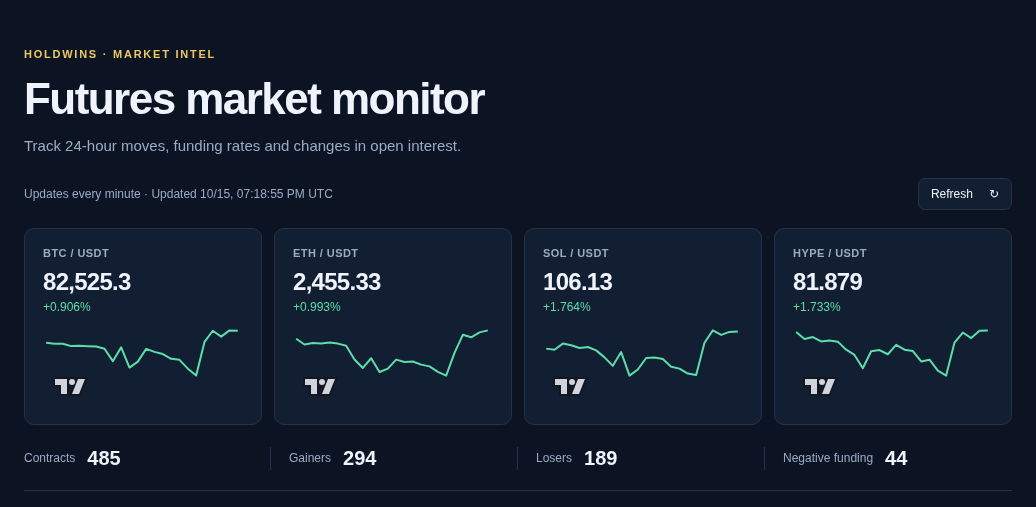
HoldWins interface captured on October 15, 2026.
The futures market monitor currently shows 24-hour price change alongside one-hour OI change. Those columns cannot be combined directly into the same-period table above. For an hourly comparison, check price and OI using matching start and end times.
Match the venue, contract, window and unit first. Then use volume and funding rates for context.
Frequently asked questions
What does rising OI with falling prices mean?
It means price fell while outstanding contracts increased over the same period. New bearish trading can accompany this pattern, but those two readings alone cannot prove that only shorts drove it or that price will keep falling.
How is open interest different from volume?
Open interest measures outstanding contracts at a point in time. Volume counts trades over a period. A transfer from an existing holder to a new holder can increase volume without increasing open interest.
Does higher dollar OI always mean more contracts?
No. Dollar-denominated open interest also changes with price. Compare contract or coin quantities alongside dollar value, using the same contract and measurement rules.